
Until the end of time
Chamber music concert of the Kulturkreis Glashütten featuring works of the twentieth century, centered around Olivier Messiaen's "Quatuor pour la fin du temps"
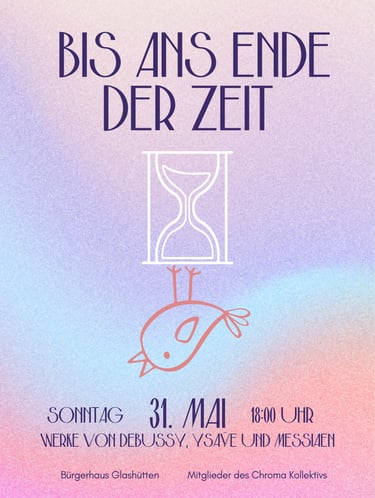
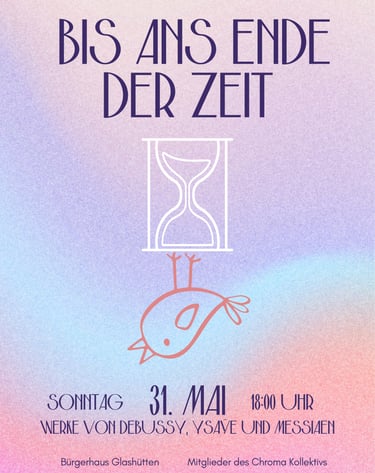
Claude Debussy’s Sonata for Violin and Piano and Eugène Ysaÿe’s Sonata No. 4 for Solo Violin serve as a prelude to the Quatuor.
Debussy composed his Sonata for Violin and Piano in the midst of the First World War. It was premiered in May 1917 with the composer himself at the piano. This would be his final public appearance; only six months later, he succumbed to cancer. A passionate nationalist, Debussy sought to distance himself deliberately from the German-Austrian musical tradition. Instead of relying on the traditional sonata-allegro form, he employed freer, more dialogic structures in order to give the work a more distinctly French character.
Eugène Ysaÿe’s Fourth Sonata for Solo Violin likewise dispenses with the traditional sonata form. Instead, it alludes to Bach’s solo violin partitas and, with movement titles such as Allemande and Sarabande, is conceived in a highly dance-like spirit. Ysaÿe published the work in 1923 and dedicated it to the violinist Fritz Kreisler.
The centerpiece of the concert is Olivier Messiaen’s Quartet for the End of Time. Composed in 1940–41 while Messiaen was imprisoned in the prisoner-of-war camp at Görlitz, it was also premiered there. Like so many of Messiaen’s works, it is deeply imbued with religious faith. Considered one of the landmark works of twentieth-century chamber music, its unusual instrumentation resulted from the particular group of musicians who happened to be interned in the camp at the time.
The work consists of eight movements, performed in various instrumental combinations. Why eight movements? Messiaen himself explained:
"Seven is the perfect number: the six days of Creation sanctified by the Sabbath. Seven becomes the Eight of unfailing light, of eternal peace.”
This statement makes the ambition of the quartet clear: it strives toward eternity, a realm liberated from time. Birds also play an important role in this vision. For Messiaen, they represented the opposite of time, serving as a bridge to God. Beyond this spiritual dimension, however, the quartet also possesses a concrete one. For the prisoners who first heard it, the “end of time” surely meant above all the end of their captivity in Görlitz. Yet for us today, in an age marked by expanding wars and climate change, the idea retains an immediate and profound relevance.
Get in touch
Please contact us for any questions or collaborations
© 2025. All rights reserved